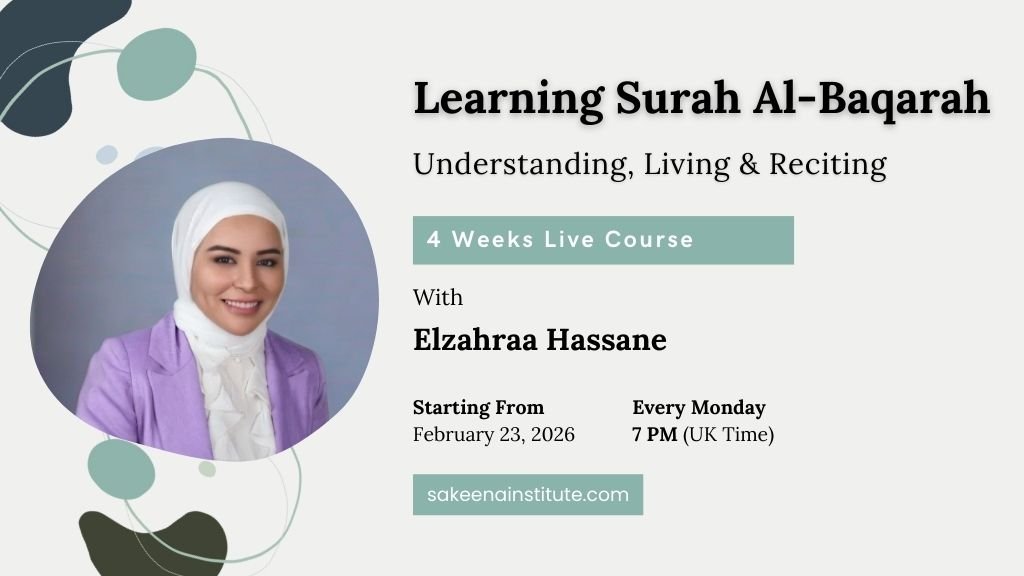
Course Start Date: 23 February 2026 (Live on Zoom)
Access: Lifetime access to all recorded sessions via dashboard
Offered by: Sakeena Institute
Understanding, Living & Reciting
Date of Start: 23 February 2026
Time: 7 PM UK time
Duration: 4 Weeks
Sessions: 1 session per week
Session Length: 2- 3 hours
Course Curriculum
Surah Al-Baqarah is not just the longest chapter in the Qur’an, it is a complete program for life. It teaches belief, patience, law, identity, resilience, and surrender.
In this 4-week journey, we will move step by step through the entire Surah, understanding its stories, reflecting on its lessons, and learning how to recite it properly.
By the end of the course, students will have:
- Covered the entire Surah (1–286)
- Understood its main themes and stories
- Improved their recitation
- Built a structured way to continue learning it independently
Programme Structure
- Teaching & Interpretation (Stories + Themes)
- Practical Guidance on Learning the Surah
- Guided Recitation with a Qualified Reciter
Week 1:
The Beginning of Guidance & The Story of Adam
What We Cover
- Verses 1–20: The three types of people (believers, disbelievers, hypocrites)
• Verses 21–39: The story of Adam (AS) and Shaytan
• Verses 40–74: The early story of Bani Isra’il and lessons in obedience
Focus of This Week
- Understanding what true guidance is
• Recognizing spiritual diseases (hypocrisy, arrogance, ingratitude)
• Learning how stories in the Qur’an teach us about ourselves
• How to approach long surahs without feeling overwhelmed
Recitation Practice
- Recitation of selected passages from 1–74
• Correct pronunciation and tajweed reminders
• Students recite along with the reciter behind screens
• Tips for memorizing small daily portions
Week 2:
Lessons from Bani Isra’il & The Path of Submission
What We Cover
- Verses 75–103: Continued lessons from Bani Isra’il and consequences of distortion
• Verses 104–123: Warnings against pride and selective obedience
• Verses 124–141: The story of Prophet Ibrahim (AS) and building the Ka‘bah
Focus of This Week
- Learning from repeated mistakes of past nations
• Understanding the danger of partial obedience
• Seeing how Prophet Ibrahim (AS) represents complete submission
• Strengthening our identity as a nation of faith and balance
Recitation Practice
- Recitation of selected passages from 75–141
• Improving flow and connection between verses
• Practicing correct stopping and starting (waqf rules)
• Encouragement to begin a daily Surah Al-Baqarah reading habit
Week 3:
Identity, Law & Tests of Faith
What We Cover
- Verses 142–152: Change of Qiblah and obedience without hesitation
• Verses 153–177: Patience, prayer, and true righteousness (Al-Birr)
• Verses 178–214: Legal foundations and trials of believers
• Verses 215–252: Spending, striving, Ayat al-Kursi, and the story of Talut and Jalut
Focus of This Week
- Understanding obedience even when we do not understand
• Seeing how faith is strengthened through trials
• Reflecting on Ayat al-Kursi and Allah’s absolute sovereignty
• Recognizing how Surah Al-Baqarah builds a strong Muslim identity
Recitation Practice
- Recitation of selected passages from 142–252
• Reading longer passages with steady rhythm
• Breath control and confidence in recitation
• Encouraging memorization of Ayat al-Kursi
Week 4:
Financial Ethics, Accountability & Complete Surrender
What We Cover
- Verses 253–266: Charity and the psychology of giving
• Verses 267–283: Riba (usury), financial justice, and the longest verse (debt and contracts)
• Verses 284–286: Accountability of the heart and the powerful closing du‘ā
Focus of This Week
- Understanding responsibility in society
• Learning Qur’anic principles of financial integrity
• Reflecting on inner accountability before Allah
• Internalizing: “Allah does not burden a soul beyond what it can bear” (2:286)
• Leaving the course with a lifelong connection to Surah Al-Baqarah
Recitation Practice
- Recitation of selected passages from 253–286
• Collective recitation of the final verses (285–286)
• Revision of key recitation corrections
• Creating a personal continuation plan for regular recitation