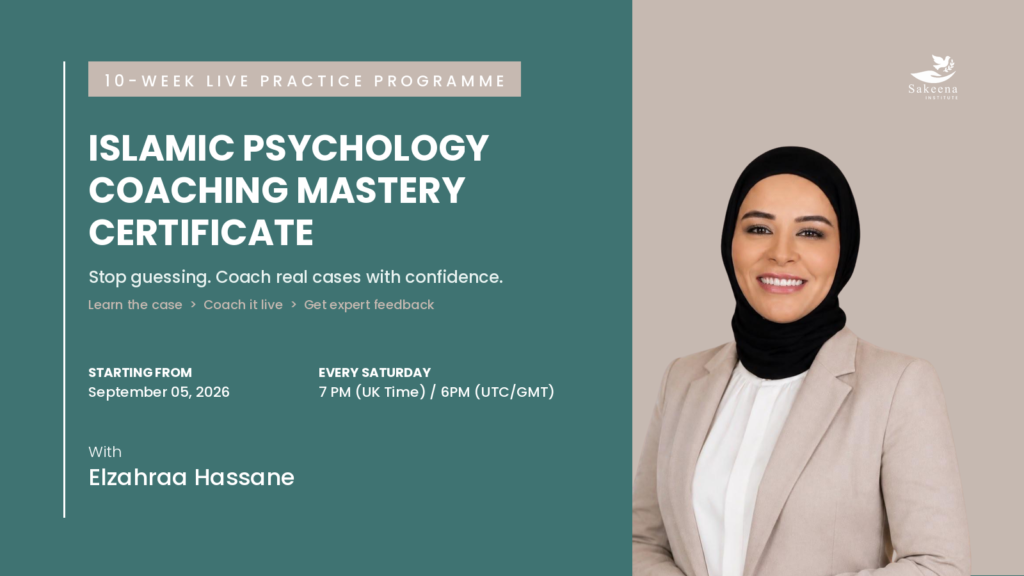
Islamic Psychology Coaching Mastery™ is a ten-week professional development programme for aspiring and Islamic psychology coaches who want to move from theoretical knowledge into confident, skilled and ethically responsible coaching practice.
Across ten live modules, participants work with real emotional, behavioural, relational and spiritual challenges that Muslims may bring into coaching. Each module focuses on one presenting issue. Participants receive focused teaching on its psychological, Islamic and coaching dimensions, followed by case analysis, live coaching practice, guided feedback and professional reflection.
Every module follows the same practical learning cycle: learn, understand the case, coach, receive feedback, reflect and improve.
The aim of the programme is to make participants more capable of applying Islamic psychology in real coaching conversations.
Case scenario: “I keep thinking about everything that could go wrong. I make duʿāʾ and try to trust Allah, but I still cannot stop worrying.”
This module explores worry, rumination, fear, uncertainty and the desire for control. Participants examine these experiences from psychological and Islamic perspectives, including the appropriate application of tawakkul, taking the means, duʿāʾ and reliance upon Allah.
The coaching component develops the ability to explore fear without reinforcing it, identify unhelpful patterns of thinking, ask purposeful questions and support realistic action. Participants also consider when anxiety-related concerns may extend beyond coaching scope and require additional professional support.
Practice focus: advanced questioning, reflective listening, exploring uncertainty, appropriate Islamic integration and referral awareness.
Case scenario: “Everyone around me seems to be moving forward. I feel left behind, and sometimes I wonder whether there is something wrong with me.”
This module examines comparison, rejection, external validation and beliefs surrounding personal worth. Participants explore how repeated experiences and social comparison can shape the way a person interprets themselves, their achievements and their future.
Islamic perspectives on human dignity, individual tests, qadr and worldly measures of success are considered alongside psychologically informed coaching approaches.
Practice focus: identifying underlying beliefs, challenging assumptions appropriately, exploring comparison, strengthening reflective questioning and avoiding premature reassurance.
Case scenario: “I have been making duʿāʾ for marriage for years. Every proposal seems to fail. I am beginning to think marriage may never happen for me.”
This module explores the emotional impact of delayed marriage, repeated rejection, loneliness, social expectations, family pressure and attachment to particular outcomes.
Participants examine how Islamic concepts including qadr, duʿāʾ, ṣabr, hope and taking appropriate means can be incorporated without making promises about outcomes or dismissing the coachee’s emotional experience.
Practice focus: exploring expectations, responding to disappointment, distinguishing acceptance from hopelessness and maintaining a non-directive coaching approach.
Case scenario: “I have asked Allah for this for years. Nothing has changed. I know I should trust Allah, but I am becoming tired of asking.”
This module examines the emotional experience of prolonged waiting and apparently unanswered duʿāʾ. Participants explore disappointment, expectations, hope and uncertainty, including how emotional distress may influence a person’s interpretation of their relationship with Allah.
The module develops the ability to make space for difficult emotions while appropriately exploring Islamic understandings of duʿāʾ, divine wisdom, hope and trust in Allah.
Practice focus: faith-sensitive questioning, emotional validation, avoiding judgement of a person’s īmān and recognising spiritual bypassing.
Case scenario: “I know that Allah can forgive me, but I cannot forgive myself. I still feel ashamed whenever I remember what happened.”
This module explores the distinction between guilt and shame and examines how past mistakes can become connected to identity and self-perception.
Participants consider Islamic teachings surrounding tawbah, personal responsibility, Allah’s mercy and hope, while learning how to support reflection without minimising wrongdoing or reinforcing destructive shame.
Practice focus: exploring guilt and identity, distinguishing behaviour from self-concept, appropriate Islamic integration and maintaining professional coaching boundaries.
Case scenario: “I know I need boundaries, but they are my family. Whenever I say no, I feel that I am being a bad Muslim.”
This module examines people-pleasing, fear of rejection, guilt, family expectations and difficulties establishing healthy interpersonal boundaries.
Participants explore culturally and religiously sensitive situations involving family relationships and learn to distinguish between helping a coachee reach an informed decision and making decisions on their behalf.
Practice focus: boundary conversations, values exploration, guilt, assertive communication, non-directive coaching and culturally sensitive Islamic integration.
Case scenario: “People keep telling me to have ṣabr and accept Allah’s decree. I believe in Allah, but I am still deeply hurting.”
This module introduces coaching considerations surrounding grief, significant loss and major life transitions. Participants examine the misconception that strong faith should eliminate sadness and explore Islamic understandings of grief, ṣabr, acceptance and hope.
Particular attention is given to professional scope and recognising when bereavement or emotional distress requires specialised therapeutic or clinical support rather than coaching alone.
Practice focus: holding space, empathic listening, responding to emotional expression, avoiding premature problem-solving and recognising referral needs.
Case scenario: “I know what I need to do, but I keep delaying it. Afterwards I feel guilty and promise myself that tomorrow will be different.”
This module explores procrastination, avoidance, motivation, habit formation, perfectionism and fear of failure. Participants consider relevant behavioural principles alongside Islamic concepts including niyyah, consistency, personal responsibility, striving and discipline of the nafs.
The focus is on helping the coachee move from awareness of the problem towards practical and sustainable behavioural change.
Practice focus: identifying barriers, exploring avoidance, developing realistic goals, supporting accountability and moving from insight towards action.
Case scenario: “I still pray, but I do not feel what I used to feel. I feel distant from Allah and I do not understand what has happened to me.”
This module examines spiritual fluctuations, emotional exhaustion, expectations surrounding worship, guilt and the relationship between psychological wellbeing and spiritual experience.
Participants learn not to assume that emotional difficulty necessarily indicates weak faith, while also recognising that not every spiritual concern should be interpreted as a psychological problem.
Practice focus: exploring meaning before offering solutions, spiritually sensitive listening, avoiding assumptions and distinguishing coaching concerns from matters requiring religious or mental health referral.
Case scenario: “I am 37 and unmarried. Another proposal recently ended. My family compares me with my sister, I have withdrawn from friends, and I sometimes wonder whether Allah is punishing me for mistakes from my past. I overthink everything and no longer know where to begin.”
The final module brings together the knowledge and coaching skills developed throughout the programme. Participants work with cases where several concerns exist at the same time. They learn how to identify the presenting issue, recognise underlying themes, establish priorities and decide what should be explored first rather than attempting to solve everything at once.
The module consolidates advanced questioning, Islamic psychology integration, professional boundaries, ethical judgement and appropriate referral.
Practice focus: extended coaching practice, complex case analysis, prioritisation, professional judgement, Islamic integration, boundaries and reflective feedback.
Every live module combines five elements:
Participants are not attending ten lectures. Every module is an opportunity to learn and then actively practise what has been taught.
By the end of the programme, participants should be able to:
The programme is delivered over ten consecutive Saturdays because professional coaching competence develops through repeated application rather than theory alone. Participants move through a continuous cycle of learning, practising, receiving feedback, reflecting and applying again.
As the programme progresses, scenarios become increasingly complex, allowing participants to strengthen their coaching competence, confidence, ethical awareness and professional judgement.
The programme is especially valuable for those who recognise themselves in statements such as:
“I understand the theory, but I need more practice.”
“I want to know what to actually say when someone brings me a difficult case.”
“I want feedback on my coaching rather than practising alone.”
“I want to become more confident integrating Islamic psychology into real conversations.”
It may also support practitioners and educators seeking structured professional development in faith-sensitive coaching, provided that participants work within the boundaries of their own professional competence.
Islamic Psychology Coaching Mastery™ is an opportunity to keep practising, keep developing and become progressively more confident in applying Islamic Psychology Coaching in real-life situations.
| Module | Topic | Date |
|---|---|---|
| Module 1 | Anxiety, Fear and Overthinking | Saturday, 5 September 2026 |
| Module 2 | Self-Worth, Comparison and Rejection | Saturday, 12 September 2026 |
| Module 3 | Delayed Marriage and Relationship Concerns | Saturday, 19 September 2026 |
| Module 4 | Unanswered Duʿāʾ and Spiritual Disappointment | Saturday, 26 September 2026 |
| Module 5 | Guilt, Shame and Self-Forgiveness | Saturday, 3 October 2026 |
| Module 6 | People-Pleasing, Boundaries and Family Pressure | Saturday, 10 October 2026 |
| Module 7 | Grief, Loss and Major Life Transitions | Saturday, 17 October 2026 |
| Module 8 | Procrastination, Habits and Motivation | Saturday, 24 October 2026 |
| Module 9 | Spiritual Lows and Feeling Distant From Allah | Saturday, 31 October 2026 |
| Module 10 | Integrative Coaching Practice: Complex and Layered Cases | Saturday, 7 November 2026 |
10 live modules | 10 weeks | Every Saturday
The Certified Islamic Psychology Coach — CPD Course is a faith-based coaching course offered by Sakeena Institute (operated by Sakeena for Publishing and Training FZE LLC). It equips graduates to provide non-clinical, faith-centred coaching and personal-development support grounded in Islamic principles.
The course is accredited by The CPD Group and delivered by an Approved CPD Provider. Sakeena Institute is recognised by the International Practitioners of Holistic Medicine (IPHM) within the holistic and wellness sector.
This certificate confirms completion of a Continuing Professional Development course. It does not confer the title of psychologist, counsellor, or therapist, and does not authorise the holder to diagnose or treat any mental-health condition. Graduates practise within the scope of coaching and refer clients to licensed professionals where clinical needs arise.

We are here to guide you toward healing, peace, and understanding through the wisdom of Islam.
© 2025 Sakeena Institute (Licensed by SPC FZ). All Rights Reserved.
Want to receive push notifications for all major on-site activities?
Struggling with your mental health? Book your private consultation with our specialists.