
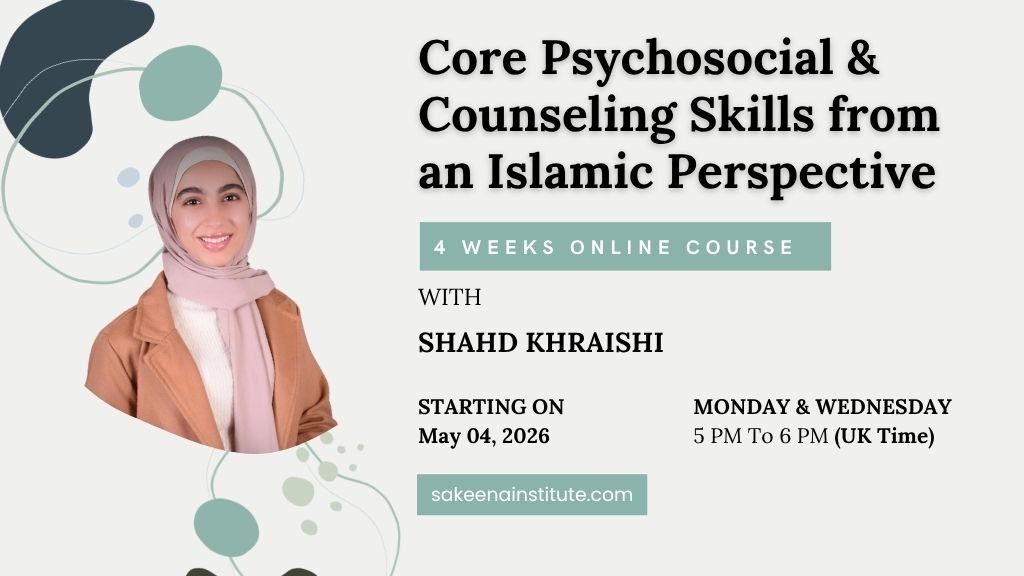
This course provides a focused introduction to essential counseling and psychosocial skills grounded in both contemporary psychology and Islamic teachings. Across eight lectures, participants will develop practical helping skills while exploring their roots in the Qur’an and Sunnah. Emphasis is placed on application, ethical awareness, and spiritual depth in helping relationships.
• Apply foundational counseling skills in real-life interactions
• Demonstrate active listening, empathy, and emotional validation
• Integrate Islamic values into psychosocial support
• Maintain ethical boundaries in helping roles
• Develop self-awareness as a helper
• Core Skill: Intentional and ethical presence
• Understanding the role of a helper in Islam and psychology
• Niyyah (intention) as the foundation of helping
• Ihsān as quality of presence
• Practice: Setting intention and role clarity
• Core Skill: Creating a safe relational space
• Psychological safety and trust
• Amanah (trust) and confidentiality
• Non-judgmental presence
• What breaks trust (e.g., shame, dismissal)
• Practice: safe language
• Core Skill: Deep listening and presence
• Hearing vs listening
• Reflective listening skills
• Avoiding interruption and premature advice
• Listening as an act of worship
• Practice: Paraphrasing and reflecting feelings
• Core Skill: Understanding and validating emotions
• Emotional validation as a core counseling skill
• Rahmah in human interactions
• Validating feelings without endorsing harmful actions
• Practice: Naming and validating emotions
• Core Skill: Managing emotions (self & others)
• Emotional regulation vs suppression
• Sabr as active emotional control
• Responding vs reacting
• Supporting others in distress
• Practice: Grounding techniques (breathing, dhikr)
• Core Skill: Building hope and resilience
• The psychology of hope
• Raja’ (hope in Allah) and avoiding despair
• Meaning-making in hardship
• Avoiding toxic positivity
• Practice: Reframing with balance
• Core Skill: Ethical advising and limit-setting
• When to advise vs when to listen
• Adab of naseeha
• Boundaries in helping relationships
• Recognizing limits and referring
• Practice: Giving advice appropriately
• Core Skill: Reflective and ethical self-development
• Self-awareness in counseling
• Personal bias and reactions
• Tazkiyah as ongoing inner work
• Avoiding burnout and over-identification
• Practice: Reflective journaling and self-check-ins
Integration session with case studies
Teaching Approach
• Short lectures + practical exercises
• Real-life scenarios
• Reflection questions each session
• Qur’an & Sunnah integration throughout
1. Concept explanation (psychology)
2. Islamic grounding (Qur’an & Sunnah)
3. Real-life examples
4. Skill demonstration
5. Practice activity

We are here to guide you toward healing, peace, and understanding through the wisdom of Islam.
© 2025 Sakeena Academy (Licensed by SPC FZ). All Rights Reserved.
Want to receive push notifications for all major on-site activities?
Struggling with your mental health? Book your private consultation with our specialists.