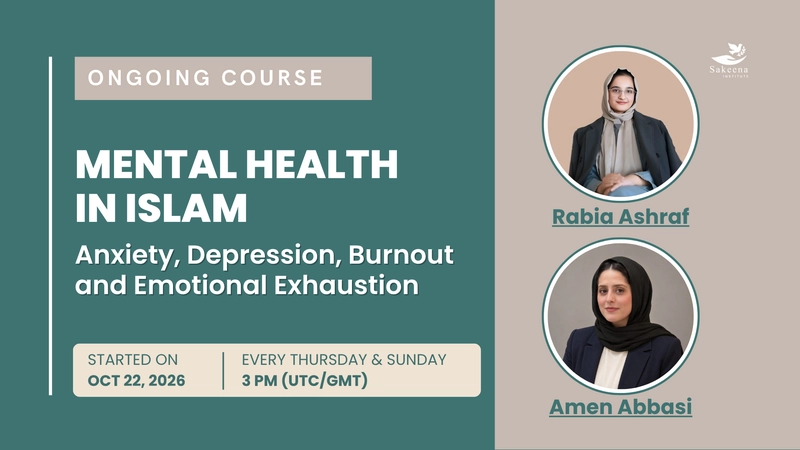
Anxiety, Depression, Burnout and Emotional Exhaustion
10 Live Modules | Every Thursday and Sunday, 3:00 to 4:00 pm UTC | Starts Thursday, 22 October 2026
“Verily, in the remembrance of Allah do hearts find rest.” (Qurʾān 13:28)
Your heart was created to find rest in Allah. Yet when anxiety will not let the mind settle, or sadness and exhaustion weigh the heart down, that rest can feel very far away. Anxiety, depression, burnout and emotional exhaustion now touch countless Muslim families, and they are still rarely spoken about and often carried alone.
Mental Health in Islam is a ten-module live programme built on one conviction: faith, practised as the Qurʾān and the Sunnah teach it, is the strongest foundation for healing the mind and heart.
Every module joins two sources of understanding. Psychology explains what is happening in your body and mind. Faith gives that experience meaning and shows you the way forward. Taking the means Allah has provided, including professional care when it is needed, is part of that faith. The Prophet ﷺ taught: “Allah has not sent down any disease without sending down a cure for it.” (al-Bukhārī)
Two specialist instructors each teach five modules within their own area of expertise. Every module follows the same clear structure:
| Part | What it covers |
|---|---|
| What you will learn | The psychology of the topic, taught clearly |
| The faith | Guidance from the Qurʾān and the Sunnah |
| Practical takeaway | A tool you can use the same day |
| Instructor | Day | Topics | Modules |
|---|---|---|---|
| Amen Abbasi | Thursdays | The foundations of faith and healing, burnout, emotional exhaustion and recovery | 1, 3, 5, 7 and 9 |
| Rabia Ashraf | Sundays | Anxiety, overthinking, stress, depression and low mood | 2, 4, 6, 8 and 10 |
| Date and time | Thursday, 22 October 2026 | 3:00 to 4:00 pm UTC |
| Instructor | Amen Abbasi |
| Case scenario | “I pray, I read Qurʾān, I try my best. So why do I still feel so anxious and low?” |
| What you will learn | How the Qurʾān and the lives of the Prophets speak of grief, fear and distress, the Islamic understanding of the human being as body, mind (ʿaql), heart (qalb) and soul (nafs), and how Islamic psychology and modern science work together. |
| The faith | The Prophets felt fear and grief, and their turning to Allah carried them through. Faith practised fully joins tawakkul with taking the means. “Allah does not burden a soul beyond its capacity.” (Qurʾān 2:286) |
| Practical takeaway | Replacing shame and self-blame with understanding, and beginning the programme with a heart turned towards Allah. |
| Date and time | Sunday, 25 October 2026 | 3:00 to 4:00 pm UTC |
| Instructor | Rabia Ashraf |
| Case scenario | “My heart races and I cannot switch off. I make duʿāʾ, but the fear does not go away.” |
| What you will learn | What anxiety is, how the body’s stress response works, how holding fear (khawf) and hope (rajāʾ) together brings balance to the heart, and when professional support is needed. |
| The faith | The Prophet ﷺ sought refuge in Allah from anxiety and grief, and Allah sends sakīnah, tranquillity, into the hearts of the believers (Qurʾān 48:4). |
| Practical takeaway | Grounding and breathing techniques combined with dhikr and Prophetic duʿāʾ to calm the body and settle the heart. |
| Date and time | Thursday, 29 October 2026 | 3:00 to 4:00 pm UTC |
| Instructor | Amen Abbasi |
| Case scenario | “I cannot say no, even when I have nothing left. Then I feel resentful, and guilty for feeling resentful.” |
| What you will learn | The patterns that sustain burnout: perfectionism, people-pleasing and the difficulty of saying no, and how a misunderstanding of iḥsān can turn sincere effort into overwork and self-neglect. |
| The faith | “Your body has a right over you.” (al-Bukhārī) Sincerity (ikhlāṣ), acting for Allah alone, frees the heart from needing everyone’s approval. |
| Practical takeaway | Recognising the patterns that drain your energy and changing them with renewed sincerity. |
| Date and time | Sunday, 1 November 2026 | 3:00 to 4:00 pm UTC |
| Instructor | Rabia Ashraf |
| Case scenario | “I replay conversations for hours and imagine every way things could go wrong.” |
| What you will learn | Rumination and “what if” thinking, how waswasa and intrusive thoughts are understood in the Islamic tradition, and the thinking patterns that fuel worry, such as catastrophising and mind-reading. |
| The faith | True tawakkul: tie the camel, then trust in Allah. Do your part and leave the outcome with Him. “Whoever relies upon Allah, He is sufficient for him.” (Qurʾān 65:3) |
| Practical takeaway | A clear method for noticing, questioning and releasing repetitive thoughts, and handing what lies beyond your control to Allah. |
| Date and time | Thursday, 5 November 2026 | 3:00 to 4:00 pm UTC |
| Instructor | Amen Abbasi |
| Case scenario | “I know I need to slow down, but resting feels like laziness.” |
| What you will learn | Rest as an Islamic value and a necessity, healthy boundaries in family, work and community life, and the Prophetic principle that the most beloved deeds to Allah are those done consistently, even if small. |
| The faith | “And We made your sleep a means of rest.” (Qurʾān 78:9) Renewed intention (niyyah) turns daily effort back into worship. |
| Practical takeaway | A personal recovery plan with realistic changes to your weekly routine. |
| Date and time | Sunday, 8 November 2026 | 3:00 to 4:00 pm UTC |
| Instructor | Rabia Ashraf |
| Case scenario | “I am always running. I cannot remember the last time I felt rested.” |
| What you will learn | Healthy pressure versus chronic stress, its effect on sleep, health, relationships and worship, and a personal stress map of your main sources of pressure. |
| The faith | The five daily prayers are anchors of stillness in a crowded day. “Seek help through patience and prayer.” (Qurʾān 2:153) |
| Practical takeaway | Daily stress-management habits built around prayer times, rest and realistic planning. |
| Date and time | Thursday, 12 November 2026 | 3:00 to 4:00 pm UTC |
| Instructor | Amen Abbasi |
| Case scenario | “I support everyone, but no one asks how I am.” |
| What you will learn | Compassion fatigue, unprocessed grief and suppressed emotion, and the clear difference between emotional strength and emotional suppression. |
| The faith | At the death of his son Ibrāhīm, the Prophet ﷺ wept and said: “The eyes shed tears and the heart grieves, and we say only what pleases our Lord.” (al-Bukhārī) Tears and contentment with Allah live together. |
| Practical takeaway | Healthy ways to express and release emotion before Allah and with trusted people, without guilt. |
| Date and time | Sunday, 15 November 2026 | 3:00 to 4:00 pm UTC |
| Instructor | Rabia Ashraf |
| Case scenario | “I used to love what I do. Now I feel nothing, and I am tired before the day begins.” |
| What you will learn | What burnout is and the three core signs: exhaustion, detachment and a reduced sense of achievement, with a focus on parents, carers, professionals and those who serve, and a guided burnout self-assessment. |
| The faith | Islam guards against depletion through balance: “The religion is ease, and no one overburdens himself in religion except that it overwhelms him.” (al-Bukhārī) |
| Practical takeaway | Identifying your early warning signs before burnout takes hold. |
| Date and time | Thursday, 19 November 2026 | 3:00 to 4:00 pm UTC |
| Instructor | Amen Abbasi |
| Case scenario | “I need a way forward I can keep when life becomes heavy again.” |
| What you will learn | An integrated model of wellbeing covering body, mind, heart, worship, relationships and daily life, including sleep, movement, nutrition and the support of community. |
| The faith | The relationship with Allah sits at the centre and holds every other part together. “Whoever is mindful of Allah, He will make for him a way out.” (Qurʾān 65:2) |
| Practical takeaway | A long-term wellbeing plan, centred on your connection with Allah, to return to whenever life feels overwhelming. |
| Date and time | Sunday, 22 November 2026 | 3:00 to 4:00 pm UTC |
| Instructor | Rabia Ashraf |
| Case scenario | “I go through the motions, even in prayer. I keep waiting to feel like myself again.” |
| What you will learn | The difference between sadness, low mood and depression, how low mood affects motivation, worship and relationships, and when professional help is needed. |
| The faith | Prophet Yaʿqūb said: “I only complain of my grief and sorrow to Allah,” (Qurʾān 12:86) and met his loss with beautiful patience and unbroken hope. “Your Lord has not forsaken you, nor is He displeased.” (Qurʾān 93:3) |
| Practical takeaway | Small daily steps for rebuilding energy and reconnecting with Allah and with what gives life meaning. |
Anyone facing worry, stress, low mood or exhaustion who wants to heal with faith at the centre. It is also valuable for coaches, counsellors, carers and family members who want to support others. It is for you if you have ever thought:
Attend the live sessions, or watch all recordings in the student dashboard, to receive a CPD-accredited Certificate of Completion from Sakeena Institute. The certificate records your Continuing Professional Development (CPD) hours and can be added to your professional portfolio.
| Module | Topic | Instructor | Date |
|---|---|---|---|
| Module 1 | Faith and the Mind: The Foundation of Healing | Amen Abbasi | Thursday, 22 October |
| Module 2 | Understanding Anxiety and Fear | Rabia Ashraf | Sunday, 25 October |
| Module 3 | The Hidden Roots of Burnout | Amen Abbasi | Thursday, 29 October |
| Module 4 | Overthinking: When the Mind Will Not Rest | Rabia Ashraf | Sunday, 1 November |
| Module 5 | Recovering from Burnout: Rest, Boundaries and Balance | Amen Abbasi | Thursday, 5 November |
| Module 6 | Living with Stress: Faith, Pressure and Daily Demands | Rabia Ashraf | Sunday, 8 November |
| Module 7 | Emotional Exhaustion: When the Heart Carries Too Much | Amen Abbasi | Thursday, 12 November |
| Module 8 | When Stress Becomes Burnout | Rabia Ashraf | Sunday, 15 November |
| Module 9 | The Path to Recovery: An Islamic Psychology Approach | Amen Abbasi | Thursday, 19 November |
| Module 10 | Low Mood, Depression and the Heaviness of the Heart | Rabia Ashraf | Sunday, 22 November |

We are here to guide you toward healing, peace, and understanding through the wisdom of Islam.
© 2025 Sakeena Institute (Licensed by SPC FZ). All Rights Reserved.
Want to receive push notifications for all major on-site activities?
Struggling with your mental health? Book your private consultation with our specialists.